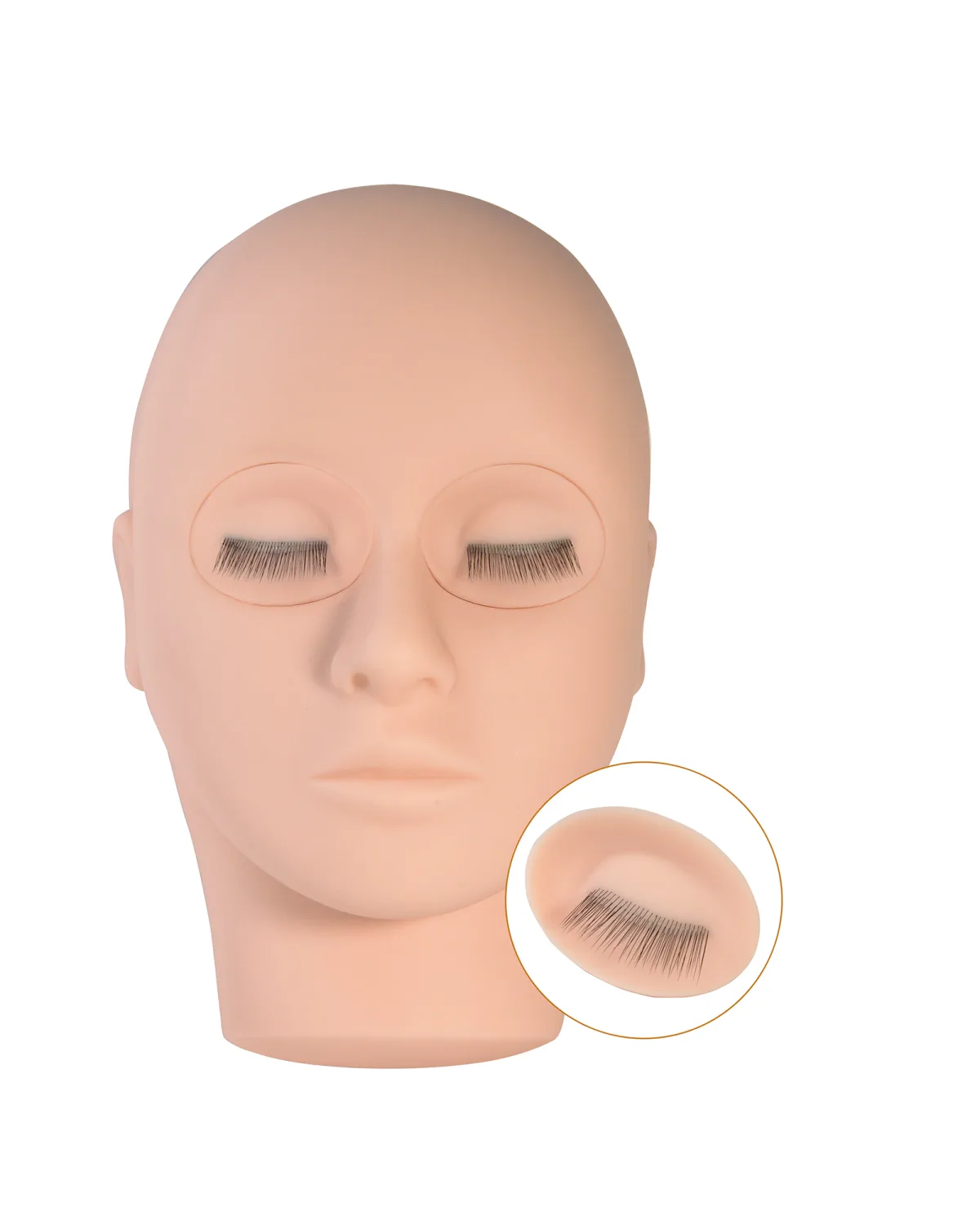
If you train lash artists in the US — running an academy, onboarding new hires in a studio, or sharpening your own speed — the practice head is the one tool every student touches every day. The wrong one falls apart in days, teaches habits that don't transfer to a paying client, and quietly burns your supply budget. This guide walks through what actually matters when you're buying for a training room, and why a 3-layer head with replaceable eye modules is built for the job.
What "best" means for a working pro, not a hobbyist
A retail buyer picking up one head for weekend practice has different priorities than a professional outfitting a class. For a US lash pro or academy, "best" comes down to four things: does the lash line behave like a real client, does it survive heavy daily use, what is the true cost per student over a term, and can you get more from one reliable supplier when you scale. Hold any practice head up against those four and most of the cheap glued-strip options drop out fast.
1. Realistic isolation — the skill that has to transfer
Isolation is the core lash-extension skill: separating one natural lash from the ones around it before you apply an extension. If a student learns it on a flat strip of glued lashes, the technique collapses the first time they sit a real client. That's the whole problem this head is engineered around.
The lash line is built in three stacked layers — about 40 lashes per layer, roughly 120 in total — to reproduce the depth and growth direction of a natural human lash line. A student can isolate a single lash from the layers beneath it exactly the way they would on a client, so isolation, classic (1:1), hybrid and volume-fan drills carry over to paying appointments instead of falling apart on the first one. True-to-life thickness, length, curl and growth direction make it a rigorous, realistic challenge rather than an easy prop.
2. Durability — it has to behave the same in month three
In a training room a head gets isolated, tugged and worked on for hours, by different hands, day after day. Glued-strip heads shed within days. Every lash on this head is individually hand-implanted into the silicone and non-detachable — no peel-off strips. It withstands isolation and gentle tugging without the lash line lifting or budging, and behaves the same in week one as in month three. One head lasts months, which is the difference between a tool you buy once a term and one you replace constantly.
The face itself is premium ultra-soft silicone with authentic skin elasticity and bounce — odor-free, eco-friendly and skin-safe. It resets clean between students: wipe with water or an oil-free makeup remover, since the non-porous surface lifts adhesive residue without soaking or scrubbing. (Full routine in our guide on how to clean a practice head.)
3. Lower cost per student — replaceable eye modules
This is the part that matters most to anyone running the numbers for a class, and it's where the replaceable-eye design pays off. The eyes are pop-out modules seated in a socket, not fixed to the head. When a lash line finally wears out from practice, you swap the eye module — not the whole head — and the silicone face plus the standard mount stay in service.
A worn lash line then costs a refill module, not a new unit, and refill modules cost a fraction of the price of a new head. For an academy that turns over students every term, that's the core of the long-run economics: an unpredictable supply bill becomes a small, planned one. Swaps take seconds with a flat-end tweezer in the inner-corner notch, so a spent eye never stalls a lesson. The practical setup for a training room is one head per student plus a stock of replacement modules kept on hand.
4. One supplier when you scale — wholesale and OEM
Buying for a class is a sourcing decision, not a retail one. These heads are made factory-direct in LashPlus's own lash workshop — hand-built on our own benches, not bought in and re-boxed — and supplied straight to lash academies, training studios, distributors and resellers, with no marketplace or reseller markup. One supplier covers the heads, the ongoing replacement eye modules, and your own branded packaging.
- Tiered wholesale pricing on request — rates scale with volume; send your quantity for a quote.
- OEM / private-label — your academy's or brand's logo and branding on the box and inserts.
- Replacement-module supply kept in steady stock, so a worn lash line never stalls a class.
- First-order samples available — try before committing a class budget.
- Worldwide shipping, tracked door to door.
One head, three disciplines
For a US studio that teaches more than lashes, the same head doubles up. The layered lash line drives lash-extension training; the smooth silicone holds pigment for eyeshadow, liner and brow-mapping practice; and the skin-like feel and bounce suit facial-massage and skincare demos. One unit, three teaching uses.
The exact build
So you know precisely what you're sourcing, here are the real specs — nothing rounded up for marketing:
- Head size: 5.9 in / 15 cm wide × 9.45 in / 24 cm tall.
- Eye module: 1.9 in / 48 mm × 1.3 in / 32 mm, pop-out replaceable.
- Lash line: 3 layers · ~120 lashes (±5%) · ~40 per layer · individually hand-implanted, non-detachable.
- Mount: standard 1-inch (2.6 cm) hole — fits most lash-training tripods and table clamps.
- Material: premium ultra-soft silicone — skin elasticity and bounce, odor-free, eco-friendly, skin-safe.
- Cleaning: wipe with water or an oil-free makeup remover.
The replaceable-eye design is patent-pending.
The bottom line for US lash pros
The best practice head for a US lash professional isn't the cheapest one on a marketplace listing — it's the one whose skills transfer to real clients, that survives a full term of daily drilling, and that keeps your cost per student low through refillable eye modules instead of throwaway heads. A 3-layer, hand-implanted, replaceable-eye head from a factory-direct supplier hits all three, and gives academies a single source for heads, refills and branded packaging as they grow. When you're ready to outfit a class, get factory-direct pricing or see the wholesale & OEM options.